Tesseract meaning
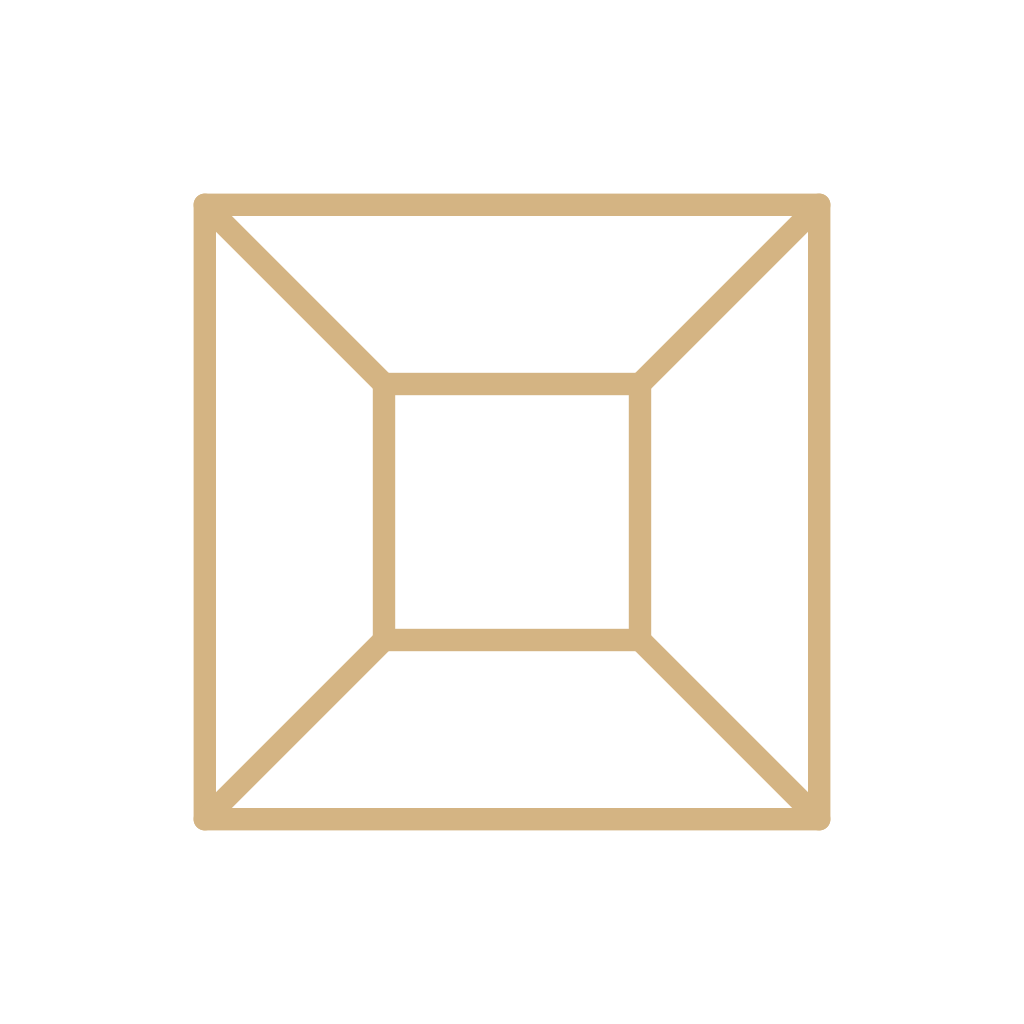
A tesseract is the four-dimensional cube, named by Charles Howard Hinton in 1888. The usual drawing is a Schlegel diagram: a cube inside a cube, corners joined. That drawing is a projection. It is not a building. The film Interstellar uses the word for a different constructed space.
A cube extended one dimension further. The drawing is a shadow of that.
The name. Tesseract is Charles Howard Hinton’s word, from Greek tessera, four. He published it in A New Era of Thought in 1888. The thing named is the four-dimensional analogue of the cube. A picture of it in three dimensions is a projection, not the object.
Where it comes from
A square is a two-dimensional cube. A cube is the three-dimensional one. The next step, eight cubical cells joined in the same regular way, cannot be built in a room. It can be described, and it can be projected. Hinton spent the 1880s trying to make the fourth dimension intuitable. He coined tesseract and proposed exercises with colored cubes. The Schlegel diagram, a perspective that puts one cell in the middle and draws the others around it, is the picture that survived. It looks like a cube within a cube. The inner cube is not “inside” the outer one in the way a box contains a box. The lines between them are edges that, in four dimensions, do not cross. They cross in the drawing because the drawing has thrown away a dimension. That is the entire difficulty of the symbol. People treat the cross as a mystical overlap. It is an artifact of projection, the way a cube’s drawing has edges that meet on the paper and do not meet in the same way in the wood. The lexicon draws the nested cube. It labels it as a diagram.
Geometry
A projection is a loss
Every picture of a tesseract is a compromise. The compromise can be exact: you can say which edges are which, and you can count the eight cells, the sixteen vertices, the thirty-two edges. Counting is the check. If a poster cannot be counted back to those numbers, it is decoration using the name. Decoration is common. The word sounds like a relic. It is a Victorian mathematician’s coinage, and the mathematics is ordinary once the definition is granted. Ordinary is a compliment. It means you can test the drawing.
In fiction
film · 2014
The word, not the diagram
Interstellar (film, 2014)
Interstellar uses tesseract for a constructed space in which a bookshelf repeats through time. The image is a library, not a Schlegel diagram. Christopher Nolan and Kip Thorne, who advised the film, were building a picture of gravity and of a message sent backward. They borrowed Hinton’s word because audiences had met it as “a cube past the cube.” The film does not depict the four-dimensional cube’s cells. It depicts a machine for seeing time. That is a reader of the word. The 1888 definition is still the nested cube you can count. A library is a set.
InterstellarIn popular culture
film · 2011
Captain America: The First Avenger / MCU
The glowing cube powers the Red Skull's weapons and is later revealed as housing the Space Stone.
The glowing cube powers the Red Skull's weapons and is later revealed as housing the Space Stone, which is a later reading of the mark.
Sourcenovel · 1962
A Wrinkle in Time
L'Engle's tesseract is a fold in space-time, explained with an ant on a string.
L'Engle's tesseract is a fold in space-time, explained with an ant on a string, which is a later reading of the mark.
Sourceother · 1954
Dalí, Corpus Hypercubus
Christ crucified on an unfolded tesseract net of eight cubes.
One of 261 possible nets.
Sourcenovel · 1940
Heinlein, 'And He Built a Crooked House'
A house built as a tesseract net folds into four dimensions in an earthquake.
A house built as a tesseract net folds into four dimensions in an earthquake, which is a later reading of the mark.
Sourcefilm · 2002
Cube 2: Hypercube
Prisoners trapped in a tesseract whose rooms warp time.
Prisoners trapped in a tesseract whose rooms warp time, which is a later reading of the mark.
SourceWorth knowing
Questions
What does the Tesseract mean?
A tesseract is the four-dimensional cube, named by Charles Howard Hinton in 1888. The usual drawing is a Schlegel diagram: a cube inside a cube, corners joined. That drawing is a projection. It is not a building. The film Interstellar uses the word for a different constructed space.
Where does the Tesseract come from?
A square is a two-dimensional cube. A cube is the three-dimensional one.
Why does Interstellar use the tesseract?
Interstellar uses tesseract for a constructed space in which a bookshelf repeats through time. The image is a library, not a Schlegel diagram.
Why does Captain America: The First Avenger / MCU use the tesseract?
The glowing cube powers the Red Skull's weapons and is later revealed as housing the Space Stone. The glowing cube powers the Red Skull's weapons and is later revealed as housing the Space Stone, which is a later reading of the mark.
Near this
- Klein bottleA closed surface with one side. In three dimensions the picture has to pass through itself.
- HexagonSix equal sides. Bees use it. A storm on Saturn shows it. Screens default to it.
- Golden ratioA cut where the whole stands to the larger part as that part stands to the smaller.
- MonolithA rectangular solid. The proportion is the whole of the design.
Sources
Named when the entry depends on a text, a date, or a standard. Catalog numbers are not invented.
Your margin
Private. It stays in this browser and never joins the canon.
symbol.wiki, edited as Sigilla. Last reviewed 20 October 2026. A reading of public tradition, not a ruling.