At a glance
- Meaning
- A late twentieth-century name for thirteen circles joined centre to centre.
- Origin
- Late 20th century as a name; the circles are a geometric figure
- Often confused with
- Tree of life: Ten sefirot. Not thirteen circles. Flower of life: Overlapping circles without this name or this full join.
- Also called
- Metatron cube
Metatron's cube meaning
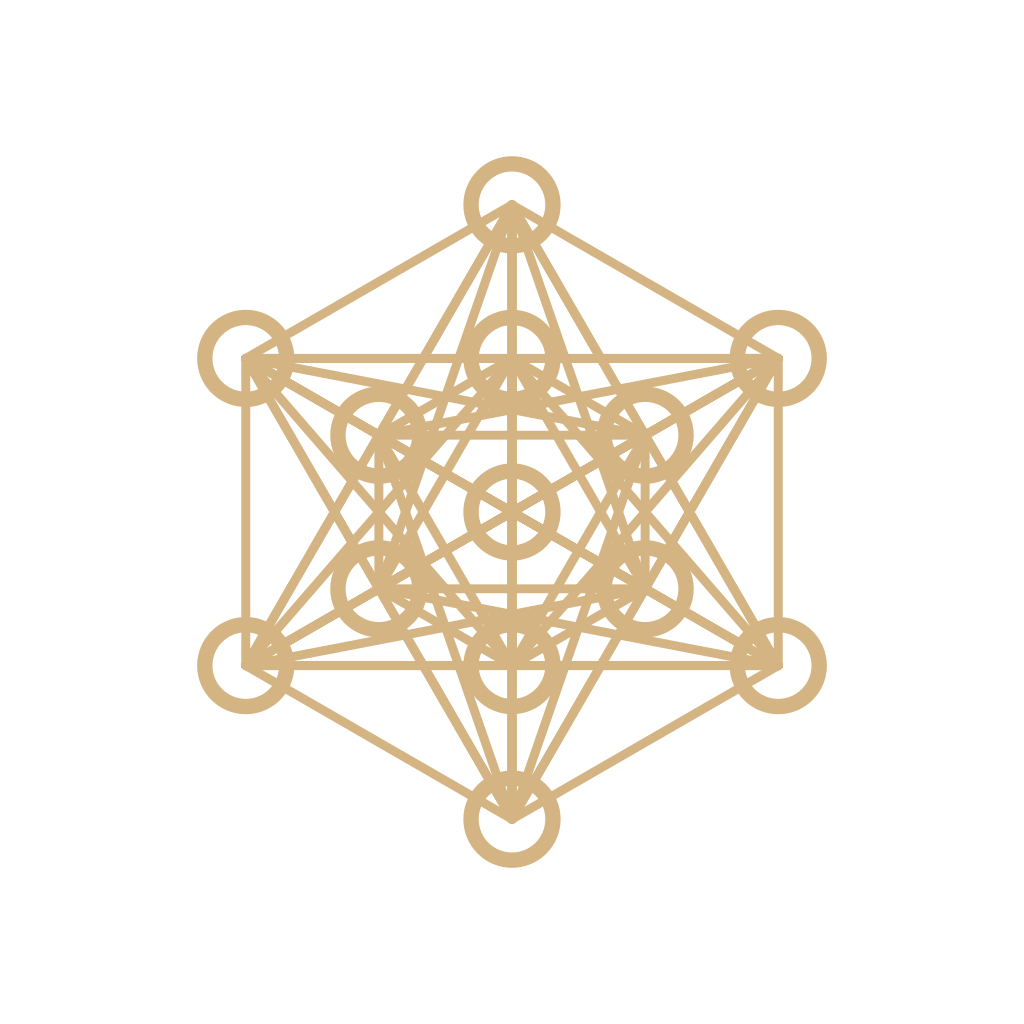
The name Metatron’s cube is late twentieth century. The figure is thirteen circles joined centre to centre. The Platonic solids can be traced in the lines. The label is not Kabbalistic, and this page does not assign it to Lawlor’s 1982 book or to Critchlow’s 1969 book.
Thirteen circles joined centre to centre. The name is late twentieth century.
The name. Metatron is a name from later Jewish angelology. The cube is a modern label for a circle figure.
Where it comes from
Say the date of the name first. Metatron’s cube is a late twentieth-century name. The figure it names is thirteen circles: one in the middle, six around it, six farther out, with lines from centre to centre. In that web you can pick out the edges of the Platonic solids. The solids are old geometry. The brand name on the web is not.
Robert Lawlor’s Sacred Geometry of 1982 and Keith Critchlow’s Order in Space of 1969 are the books people reach for when they want a scholarly grandfather. This page does not claim a page number for an absence. It does say the label is not a feature of those books as they are usually cited, and it is not a Kabbalistic diagram with a medieval pedigree. Metatron, as an angel’s name, has a history in Jewish texts that this figure does not inherit just by being called after him. Using an angel’s name is a modern act of naming. It does not move the angel onto the circles.
The drawing is the thirteen circles and the centre-to-centre lines. At a small size the lines crowd. They are still the figure. A poster that adds colours and a caption about the universe is adding a sermon. The sermon is the late twentieth century, which is where the name already lives.
Geometry
A new name on an old kind of drawing
Circles packed in a hexagon are ancient as a way of drawing. Fruit-of-life patterns, seeds, and flowers are already in this cabinet under their own names. Metatron’s cube is what happens when every centre is joined and a new title is printed underneath. The title does the selling. The joins do the geometry. A reader can trace a cube, a tetrahedron, an octahedron, and the other regular solids if the lines are all there. Tracing is a real exercise. It does not require the angel, and it does not require a claim about the Tree of Life. The tree has its own page. Thirteen circles are not ten sefirot. The count is the correction. Late twentieth century is early enough to have books and teachers and late enough that it must not be backdated onto a medieval manuscript it does not come from.
In popular culture
product · late 20th century
Sacred-geometry posters
The thirteen circles are sold as a universal diagram under the angel’s name.
The poster and the name belong to the late twentieth century. The Platonic solids do not.
SourceWorth knowing
- The solids you can trace are the geometry. The title is the late twentieth-century part. Source
Questions
How old is the name Metatron’s cube?
Late twentieth century. The circles are a geometric drawing. The angel’s name is not a medieval caption for this figure.
Is it Kabbalah?
No. The Tree of Life has ten sefirot and its own page. Thirteen joined circles are a different count and a different claim.
Did Lawlor or Critchlow name it?
This page does not find the label in Sacred Geometry (1982) or Order in Space (1969), and it does not invent a page number for that absence. The name is later.
Near this
- Flower of lifeEvery circle born on the edge of another.
- Seed of lifeSeven circles: a center, and the ring that exhausts it.
- Sri YantraNine interlocking triangles. This drawing is a simplified four-up, five-down, and it says so.

- MerkabaA modern name for two interlocking tetrahedra. The biblical word is a chariot.

- Tree of lifeTen stations of emanation, and a way back up.
Sources
Named when the entry depends on a text, a date, or a standard. Catalog numbers are not invented.
Your margin
Private. It stays in this browser and never joins the canon.
symbol.wiki, edited as Sigilla. Last reviewed 18 October 2026. A reading of public tradition, not a ruling.