
At a glance
- Meaning
- Two tetrahedra. The chariot is Ezekiel. The solid’s new name is late 20th century.
- Origin
- Ezekiel’s merkavah; Kepler’s stella octangula; the join is late 20th century
- Often confused with
- Tree of life: A diagram of sefirot. Not this solid.
- Also called
- star tetrahedron, merkavah
Merkaba meaning
Merkavah is the throne-chariot of Ezekiel 1 and a root of early Jewish mysticism. The star tetrahedron is Kepler’s stella octangula. New Age writers attached that solid to the word merkaba late in the twentieth century. The chariot and the solid are not the same object.
A modern name for two interlocking tetrahedra. The biblical word is a chariot.
The name. Hebrew merkavah, chariot. The star tetrahedron is Kepler’s stella octangula under a new label.
Where it comes from
Ezekiel 1 describes a vision of wheels and living creatures and a throne. Merkavah, chariot, is the name of that vision and of the early Jewish mystical literature that meditates on it. The literature is about a throne and a going-up. It is not a manual for drawing a polyhedron.
The star you see on posters is two tetrahedra, one pointing up and one pointing down, passing through each other. Johannes Kepler described that compound. It is the stella octangula. The geometry is seventeenth century in that description, and the solid itself is a mathematical object. Nothing in Ezekiel specifies eight triangular faces arranged as a star.
Late in the twentieth century, New Age writers took the solid, softened the Hebrew word to merkaba, and taught it as a vehicle of light or of personal ascent. The vehicle metaphor is a pun on chariot. A pun can be witty. It is not a philology and it is not a verse. This page leads with Ezekiel and with Kepler so the pun cannot arrive first.
The drawing is the two tetrahedra in isometric line. It is the solid. It is not a picture of the prophet’s wheels.
Geometry
Chariot, then a star
Geometry can host the solid without pretending to host the prophecy. The star tetrahedron is interesting as a compound: eight faces, two orientations, one centre. Kepler’s name for it is enough of a history for the shape. The mystical history of the chariot is enough of a history for the word. The late twentieth century is the history of the join. People who want one timeline will say the prophet saw the solid. Ezekiel does not draw the solid. A classroom model of the stella octangula does not become a throne by being painted gold. The isometric lines are there so the two pyramids can be counted. If you see only a hexagram, you are looking at the flat star and missing the depth the solid needs.
In popular culture
practice · late 20th century
Light-body workshops
The star is taught as a personal vehicle and called merkaba.
The workshop is the later reader. Ezekiel’s chapter is a vision of a chariot. Kepler’s solid is mathematics. The workshop is neither, and it is dated.
SourceWorth knowing
- Kepler’s name for the compound is stella octangula. Merkaba, for that solid, is a late name. Source
Questions
What is a merkaba?
In the twentieth-century usage, a star tetrahedron. In the older usage, merkavah is Ezekiel’s chariot and the mysticism of that vision. The solid was attached to the word late.
Did Ezekiel describe this solid?
He described wheels, creatures, and a throne. The stella octangula is Kepler’s compound of two tetrahedra. The join is a modern teaching.
Is it the same as Metatron’s cube?
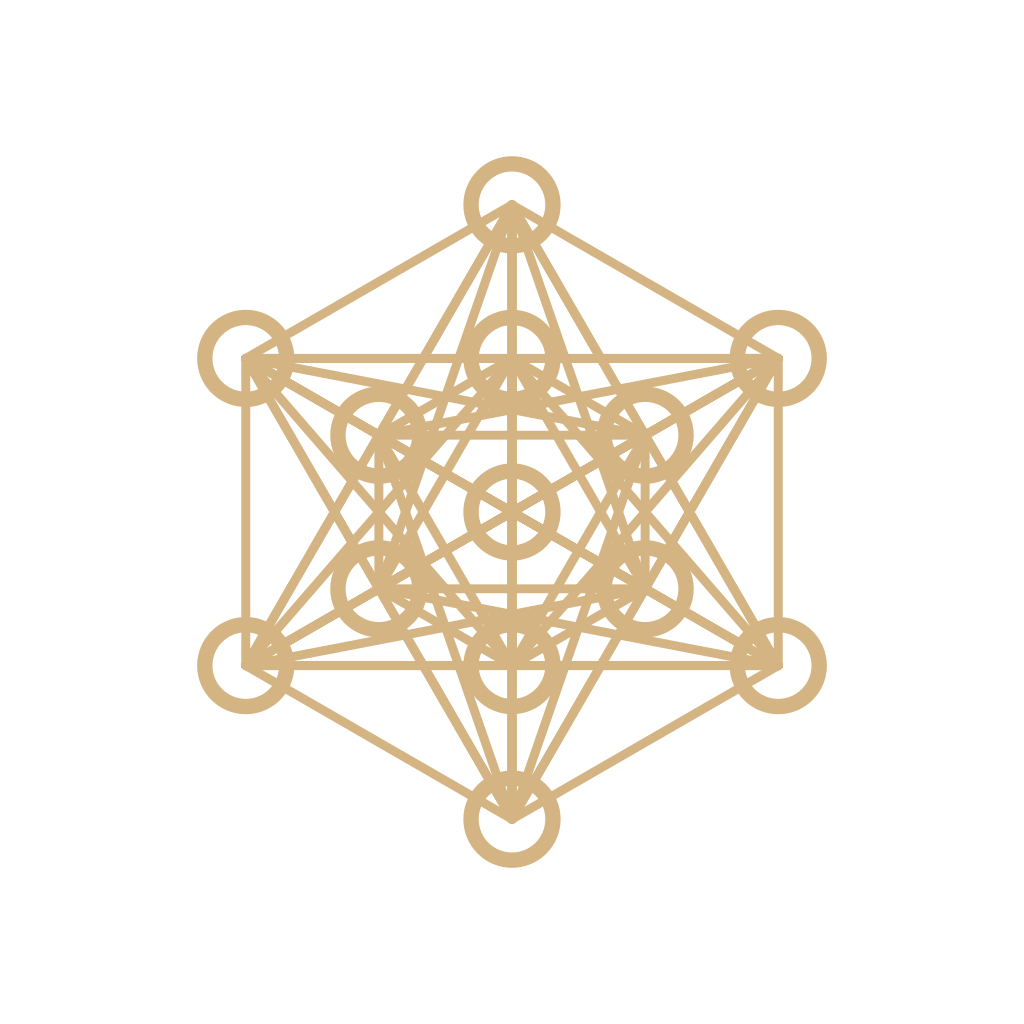
No. One is thirteen circles. One is two tetrahedra. Both names are modern labels in the poster trade. The figures differ.
Near this

Sources
Named when the entry depends on a text, a date, or a standard. Catalog numbers are not invented.
Your margin
Private. It stays in this browser and never joins the canon.
symbol.wiki, edited as Sigilla. Last reviewed 18 October 2026. A reading of public tradition, not a ruling.