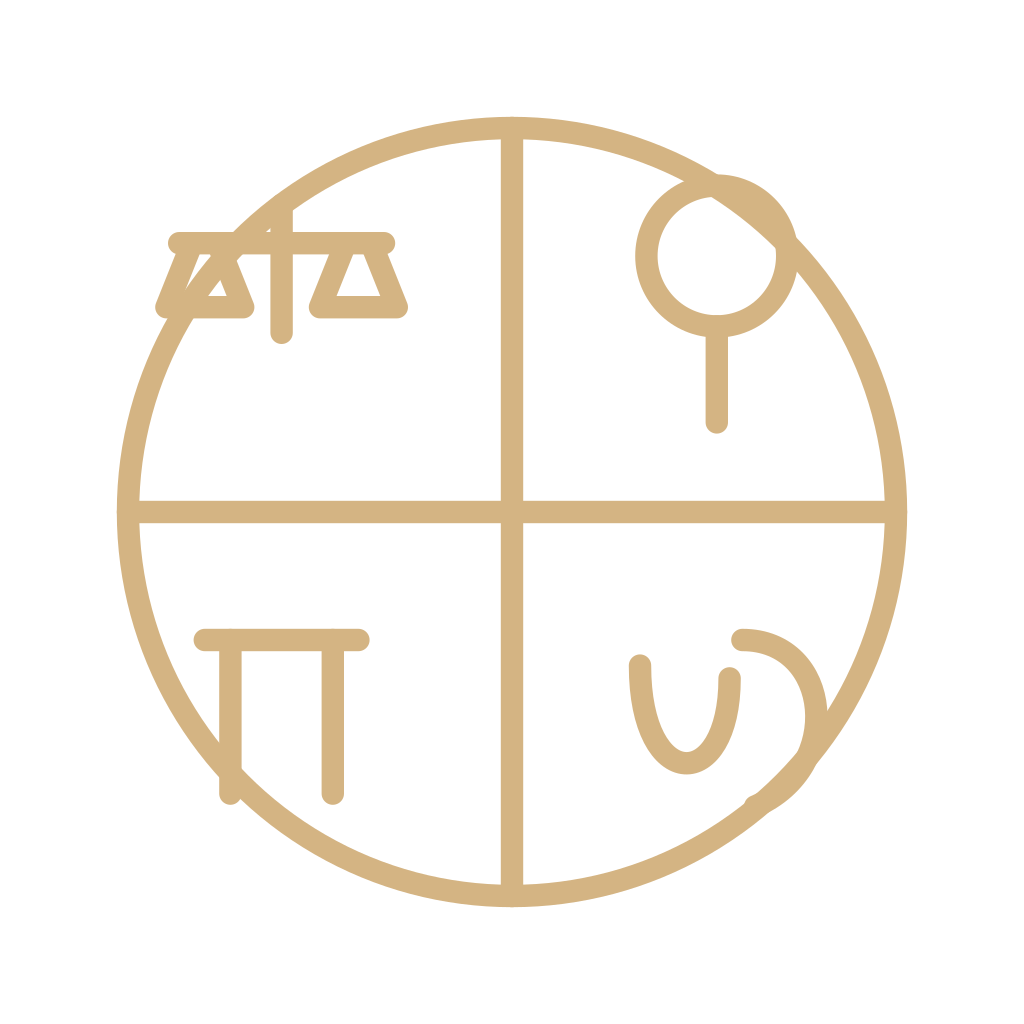
The four virtues
Also called the cardinal virtues, wisdom, courage, justice, temperance, phronesis, andreia, dikaiosune, sophrosune
Plato, 4th century BC; the Stoic list in the 3rd century BC; “cardinal” from Ambrose
Stoic symbolsThe four virtues meaning
The four virtues are wisdom, courage, justice, and temperance. The Stoics treated them as one knowledge with four faces: to have one is to have all. Painters later gave each face an object to hold.
Unicode
Scales, ⚖ U+2696, are the only one of the four with a character of their own. The character is justice’s attribute, not the set.
Four names for one good character. Later centuries put an object in each hand.
The name. Latin cardo, a hinge. Ambrose’s name for the four on which the other virtues were said to swing.
Where it comes from
Plato, in Republic IV, assigns the four to the parts of the city and of the soul. Diogenes Laertius, reporting the Stoics, says the primitive virtues are prudence, manly courage, justice, and temperance. Prudence is knowledge of what is good, bad, and indifferent. The virtues follow one another, and the person who has one has all, because the precepts are common. Chrysippus says so in the first book of his treatise on Laws. The passages are Diogenes Laertius 7.92 and 7.125.
Cicero, De Inventione II.53, fixes the number at four. Ambrose coins “cardinal,” from cardo, a hinge. Seneca, consoling his mother, substitutes pietas for courage. Marcus Aurelius names his own set in Meditations 3.6: if you find anything better than justice, truth, temperance, and fortitude, turn to it with all your soul.
The pictures come later. Prudence holds a book, a mirror, or a serpent. Justice holds a sword, scales, and sometimes a crown. Fortitude holds armour, a club, a lion, a tower, or a broken column. Temperance holds a bridle, a wheel, or water and wine in two jugs. The set is standard by the Vivian Bible of 845 and on the tomb of Clement II at Bamberg. Giotto painted seven virtues in grisaille along the Scrovegni Chapel dado, about 1305, each facing a vice. Raphael’s lunette in the Stanza della Segnatura, 1511, seats Fortitude with a lion and a Della Rovere oak, Prudence with two faces and a mirror, and Temperance with a bridle. Justice, with scales and sword, is on the ceiling, because Plato made her the harmony of the other three.
Stoic
One knowledge, four faces
The Stoic claim is not that a person collects four hobbies. It is that the person who really has justice already has the other three, because the same knowledge is at work. The objects in the paintings are a later memory system. Scales are not the definition. They are how a chapel made justice recognizable.
In popular culture
card · 15th century
The tarot trumps
The tarot keeps Justice with her scales, Strength with her lion, and Temperance pouring between two cups.
Three pictures from a card pack, not the argument that the four are one knowledge.
Sourcestudy · 2011
Representing Justice
A Yale study traces the figure of Justice from Raphael into twenty-first-century courthouses. The scales left the chapel and became the law’s.
The courthouse inherits an attribute. It does not inherit the Stoic claim that the virtues are inseparable.
Sourcebook · 2010s
The four virtues, repackaged
The modern Stoic revival sells the list as a medallion and as a run of books, courage first among them.
The packaging is contemporary. The list is not.
Sourcecatalogue · late antique
Pseudo-Andronicus
A catalogue under his name counts forty-four Stoic virtues arranged under the four.
Subordinate virtues are what the list looks like when someone writes every branch down.
SourceWorth knowing
Questions
What are the four Stoic virtues?
Prudence, courage, justice, and temperance. In Greek: phronesis, andreia, dikaiosune, sophrosune. The Stoics say that whoever has one has all.
Why are they called cardinal?
From Latin cardo, a hinge. Ambrose uses the word. The other virtues are said to swing on these four.
What objects stand for each virtue in art?
Scales for justice, a mirror for prudence, a lion or a column for fortitude, and two jugs for temperance. The objects are medieval. The list is older.
Near this
- Zeno’s handOpen palm, curled fingers, a fist, then a fist held shut. A lesson you can do with one hand.
- The StoaA painted porch in Athens. The school is named after the building, not after a badge.
- Hierocles’ circlesA person as nested rings, from the mind out to the whole human race. The work is to pull the outer rings in.
- LibraScales, set where the year balances — and once the scorpion’s claws.
Sources
- Cardinal virtues
- Diogenes Laertius 7, Fordham sourcebook
- Marcus Aurelius, Meditations 3.6
- Raphael, the cardinal and theological virtues
- Giotto at the Scrovegni Chapel
- Yale Law School, Representing Justice
- Modern Stoicism, forty-four virtues
- Nine core Stoic beliefs
- Giotto, vices and virtues
- Wheel of Fortune, the tarot trump
- The lacuna at Diogenes Laertius 7.92
Named when the entry depends on a text, a date, or a standard. Catalog numbers are not invented.
Your margin
Private. It stays in this browser and never joins the canon.
symbol.wiki, edited as Sigilla. Last reviewed 20 October 2026. A reading of public tradition, not a ruling.