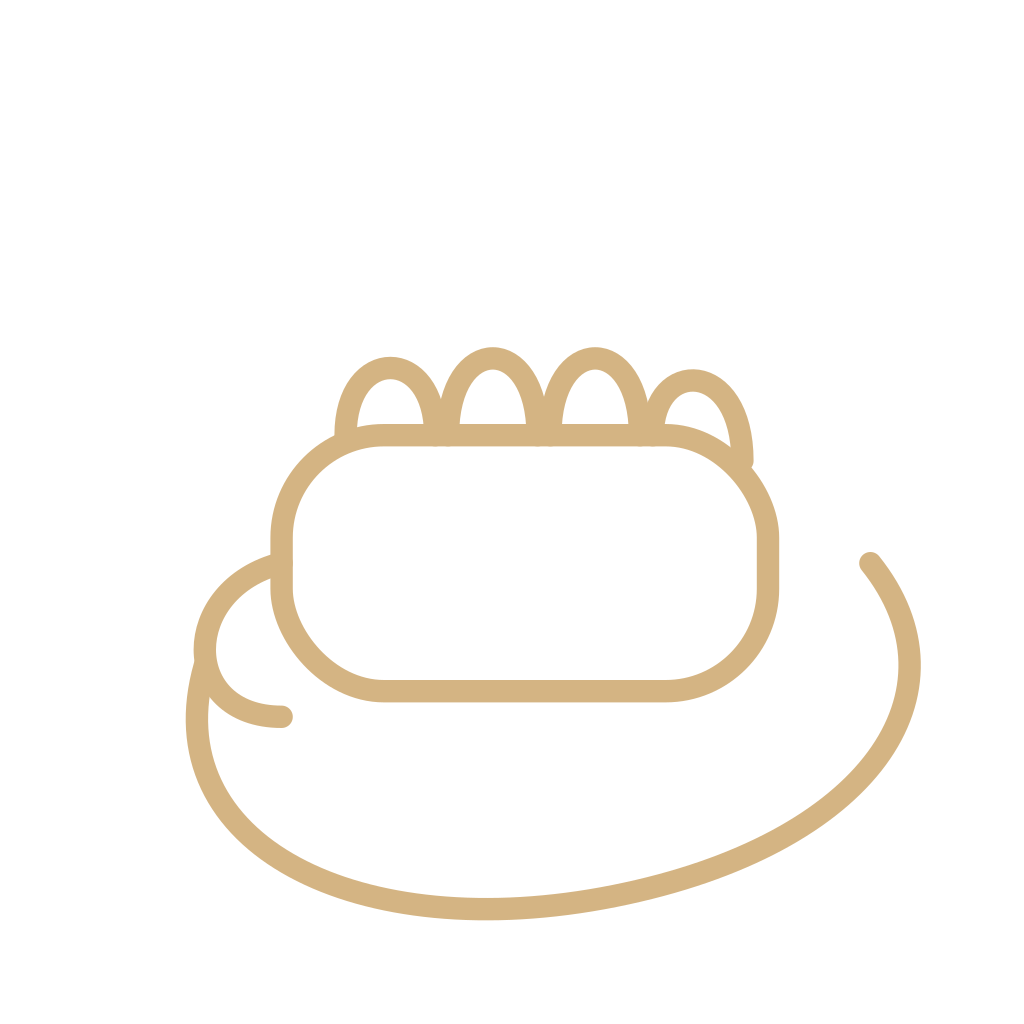
Zeno’s hand
Also called the Stoic hand, the fist of katalepsis, Zeno’s gesture
Athens, about 300 BC; written down by Cicero in 45 BC
Stoic symbolsZeno’s hand meaning
Zeno’s hand is a four-stage gesture for how a mind takes hold of an idea: an open palm, then assent, then a fist, then the other hand closed over the fist. Cicero records it. It is a lesson, not a badge.
Unicode
There is no character for the gesture. Nearest, and not the mark: ✊ U+270A raised fist, and 🖐 U+1F590 raised hand with fingers splayed.
Open palm, curled fingers, a fist, then a fist held shut. A lesson you can do with one hand.
The name. Greek katalepsis, a grasping. Cicero says Zeno named the grasp from the closed fist.
Where it comes from
The account is Cicero’s, in the Academica, the Lucullus, at 2.145. He is reporting what Zeno used to do while teaching. Zeno displayed his hand with the fingers stretched out and called that a visual appearance. He closed the fingers a little and called that assent. He pressed the fingers into a fist and called that comprehension. From the illustration he gave the process the name katalepsis, which it had not had before. Then he applied his left hand to his right fist and squeezed, and called that knowledge, which was in the power of nobody but the wise man.
Katalepsis means grasping. The Academic sceptics attacked the point. They held that no impression could be grasped with certainty, so the fist could never legitimately close. The Routledge Encyclopedia summarises the same gesture as the Stoic account of cognitive certainty.
Zeno was born about 334 BC at Citium in Cyprus. He was shipwrecked on his way to Piraeus, read Xenophon’s Memorabilia in an Athenian bookshop, and asked where men like Socrates could be found. He opened his school in 301 or 300 BC and led it for 39 years. Athens voted him a golden crown and a tomb in the Kerameikos at public expense, for making his own life a model. The honours were to be engraved on two pillars, one in the Academy and one in the Lyceum, the schools of his rivals. Diogenes Laertius says he died after tripping and breaking a toe as he left the school, striking the ground and quoting Niobe: I come, why do you call me?
Stoic
The fist is the name
The open palm is what strikes the senses. The half-closed hand is agreeing to it. The fist is holding it so it cannot be taken back. The second hand is the wise man’s knowledge, locked. Cicero says the fist gave katalepsis its name. A modern clenched-fist logo keeps only the third stage and drops the lesson.
In popular culture
essay · 2012
Donald Robertson
Robertson reads the gesture as an illustration Zeno performed, not a ritual the school practised. Treating the clenched fist as the Stoic symbol starts with recent guides.
A teaching gesture, not a salute.
Sourceessay · 2025
Unclenching the fist
Robertson turns the same gesture around and uses the opening of the fist as an image for letting go of anger.
The hand, read in reverse, is a modern exercise.
Sourceforum · 2013
r/Stoicism
Asked for a Stoic tattoo, members propose a clenched fist with another hand around it.
That is as close as the community has come to adopting a sign.
SourceWorth knowing
- Cicero says Zeno coined katalepsis from this gesture. The fist named the concept. Source
- Diogenes Laertius says Zeno died after breaking a toe, quoting Niobe: I come, why do you call me? Source
- The Athenian decree ordered the honours set on two pillars, one in the Academy and one in the Lyceum. Source
Questions
What do the four stages of Zeno’s hand mean?
An open palm is an impression. Fingers curled are assent. A fist is comprehension, katalepsis. The other hand closed over the fist is knowledge, which only the wise person was said to have.
Is the clenched fist a Stoic symbol?
It is the third stage of a gesture Cicero describes. The school did not adopt it as a badge. The fist-as-logo is a modern shortcut.
Who recorded Zeno’s hand gesture?
Cicero, in the Academica, at Lucullus 2.145, in 45 BC. He is reporting what Zeno used to do in front of a class.
Near this
Sources
- Katalepsis
- Routledge Encyclopedia, Stoicism, cognitive certainty
- UC Press, The Mask of Socrates
- Zeno of Citium
- Diogenes Laertius 7, Yonge at Attalus
- Donald Robertson, hand gestures
- The Stoic Handbook, symbols
- Donald Robertson, unclenching the fist
- r/Stoicism, a fist for a tattoo
Named when the entry depends on a text, a date, or a standard. Catalog numbers are not invented.
Your margin
Private. It stays in this browser and never joins the canon.
symbol.wiki, edited as Sigilla. Last reviewed 20 October 2026. A reading of public tradition, not a ruling.