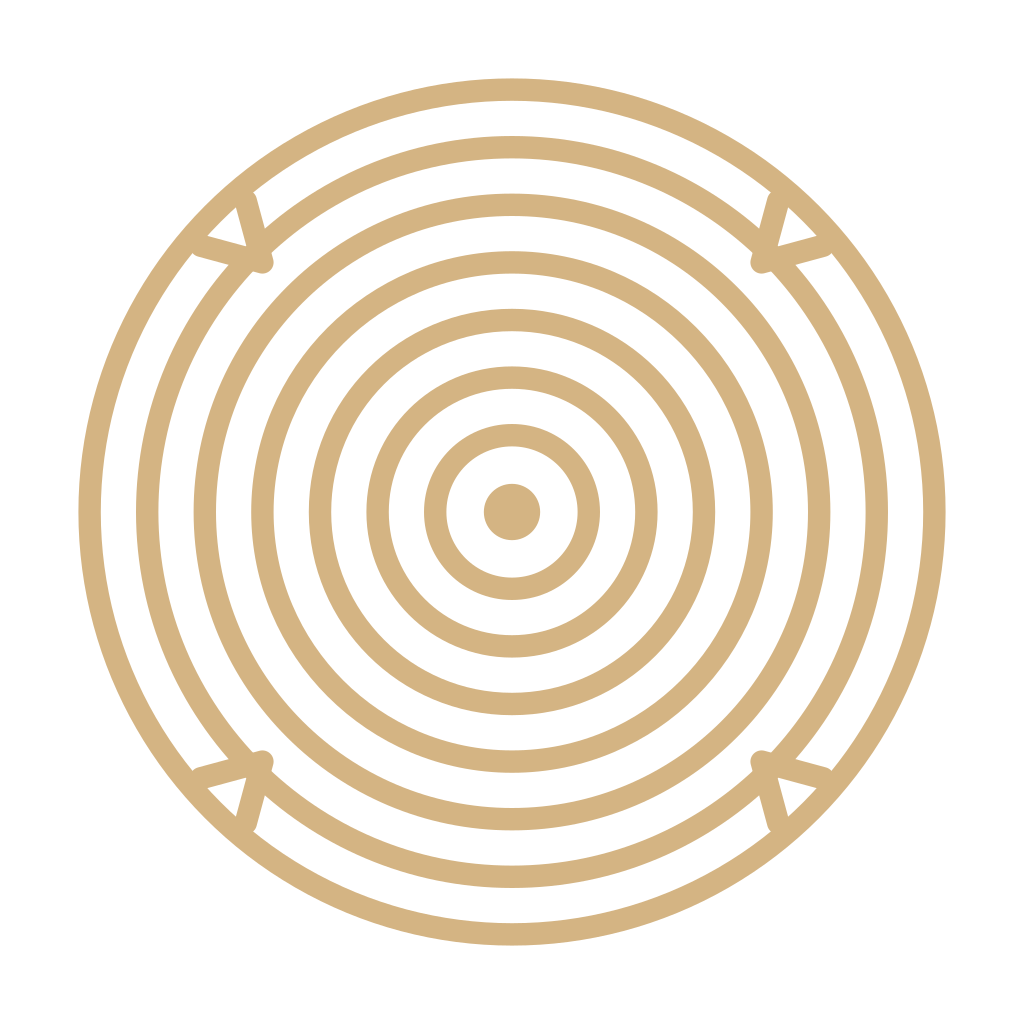
Hierocles’ circles
Also called circles of concern, the concentric circles of oikeiosis
2nd century AD; preserved by Stobaeus in the 5th century
Stoic symbolsHierocles’ circles meaning
Hierocles drew a person as nested rings: the mind at the centre, then body, family, relatives, neighbours, fellow citizens, countrymen, and at the outer edge the whole human race. The exercise is to pull the outer rings inward.
Unicode
No character is this diagram. ◎ U+25CE bullseye and ⊚ U+229A circled ring operator are lookalikes, not the mark.
A person as nested rings, from the mind out to the whole human race. The work is to pull the outer rings in.
The name. Greek oikeiosis, the taking of something as one’s own. Hierocles draws that claim as rings.
Where it comes from
Hierocles was a Stoic active most probably in the first half of the second century. His Elements of Ethics survives on a single papyrus roll, P.Berol. 9780, first edited by Hans von Arnim in 1906. The ethical excerpts survive in Stobaeus. The circles passage is Stobaeus 4.27.23. A Bryn Mawr reviewer calls it perhaps the most influential innovation Hierocles made to the Stoic ideas he had inherited.
Brad Inwood’s translation runs like this. Each of us is circumscribed by many circles. The first and most intimate is the one someone has drawn around a centre point, his own mind. In it are the body and the things adopted for the body’s sake. The second holds parents, siblings, wife, and children. The third holds uncles and aunts, grandparents, the children of siblings, and cousins. Then the rest of one’s relations, demesmen, tribesmen, fellow citizens, fellow townsmen, and those of the same people. The outermost circle is the entire human race. The duty of a serious person is to draw the circles toward the centre, and to keep moving those in the outer rings toward the inner ones.
A common count is seven circles. The ancient writing is words. No diagram survives. Every drawn version, including the one on this page, is modern. The smallest circle is practically in contact with the centre: the body is already one step out from the self. The Greek verb is a contraction, drawing the circles together. The standard English edition is Ramelli and Konstan, 2009, on Bastianini and Long’s 1992 Greek.
Stoic
Contract, do not inflate
The exercise moves other people toward you. It does not congratulate you for already caring about a distant abstraction. Singer’s expanding circle runs the arrow the other way. Covey’s circle of control is a different diagram, about effort, and Stoic apps often paste the two together. They are not the same drawing.
In popular culture
essay · 1994
Patriotism and Cosmopolitanism
Martha Nussbaum built the essay on Hierocles’ circles, and her critics answered in the same image.
A twentieth-century argument about country and cosmos, using a second-century figure.
Sourcebook · 1981
The Expanding Circle
Peter Singer runs the figure the other way, widening the circle instead of drawing it in. The title became shorthand for moral progress.
Widening reverses Hierocles. His verb pulls inward.
Sourcediagram · 1989
Circle of control
Diagrams of control, influence, and concern descend from Stephen Covey. Stoic apps routinely merge them with Hierocles.
Covey’s rings sort your effort. Hierocles’ rings sort your obligations. The merger is modern.
Sourcepaper · 2026
A discount for distance
An ethics paper still argues over whether Hierocles allows a discount rate for people who stand farther out.
The argument is current. The circles are not a graph from that paper.
SourceWorth knowing
- The smallest circle is practically in contact with the centre. The body is already one step out from the self. Source
- Hierocles’ verb draws the circles together, a contraction. Singer’s expanding circle reverses the direction. Source
- The standard English edition is Ramelli and Konstan, 2009, on Bastianini and Long’s 1992 Greek. Source
Questions
How many circles did Hierocles describe?
The usual English count is seven: mind, body and its needs, close family, wider kin, then neighbours and citizens, and at the edge the whole human race. He is listing rings, not numbering a diagram.
Did Hierocles draw a diagram?
No drawing survives. Stobaeus preserves the passage in words. Every set of rings you have seen, including this one, is modern.
Is the circle of control the same as Hierocles’ circles?
No. The circle of control comes from Stephen Covey and sorts what you can affect. Hierocles sorts people, and tells you to draw the outer rings inward.
Near this
Sources
- Bryn Mawr Classical Review, Ramelli and Konstan
- Hierocles (Stoic)
- Inwood, Hierocles: Theory and Argument
- Carnegie Council, Nussbaum
- Boston Review, on Nussbaum
- Aeon, on the cosmopolitan circle
- Figs in Winter, the circles
- Springer, Ethical Theory and Moral Practice, 2026
- StoicNow, circle of control
Named when the entry depends on a text, a date, or a standard. Catalog numbers are not invented.
Your margin
Private. It stays in this browser and never joins the canon.
symbol.wiki, edited as Sigilla. Last reviewed 20 October 2026. A reading of public tradition, not a ruling.