At a glance
- Meaning
- A pillar of stability, read as the backbone of Osiris.
- Origin
- Egypt, Old Kingdom and after; raised at Memphis
- Often confused with
- Ankh: The ankh is a loop and a crossbar. The djed is a pillar with four bars. Was-sceptre: The was is a forked staff. The djed is the pillar it is sometimes set on.
- Also called
- djed pillar, backbone of Osiris
Djed meaning
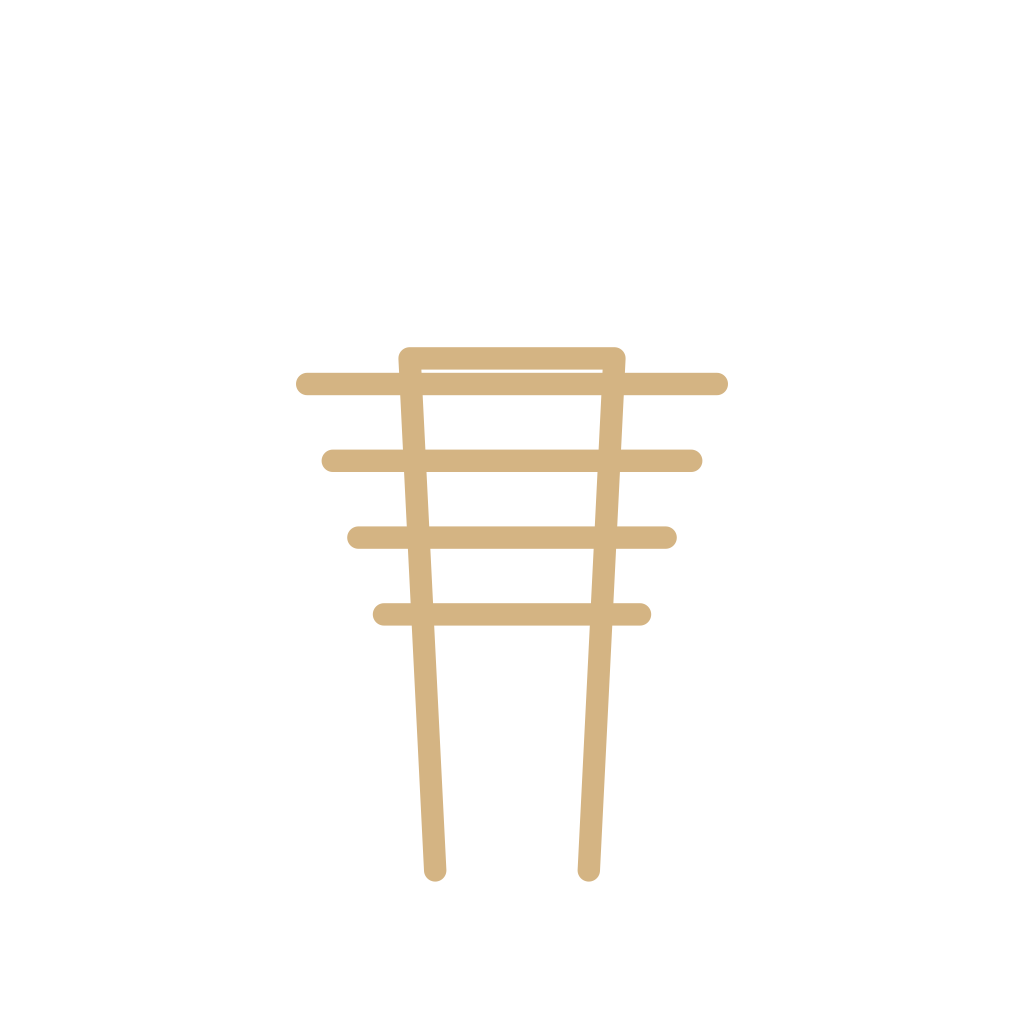
The djed is a pillar with four crossbars. It is read as stability, and as the backbone of Osiris. Raising the djed was a rite at Memphis. It is not the ankh, and it is not a was-sceptre.
A pillar with four bars, raised as stability and read as the backbone of Osiris.
The name. Egyptian djed, a word read as stability. The pillar is the sign of that word.
Where it comes from
The djed is a pillar. Four horizontal bars sit near the top, and the shaft is broader at the base. The word is read as stability. In funerary texts the pillar is also the backbone of Osiris, the god who was pulled back together. Those two readings travel together: a body that holds, and a kingdom that holds.
Raising the djed was a rite at Memphis. The pillar was set upright. The gesture is the meaning in action. A pillar lying down is not yet the sign doing its job. Kings and gods are shown beside it, and it is grouped with the ankh and the was-sceptre as a set of powers: life, stability, dominion. The grouping is old. It does not make the three drawings one drawing.
British Museum EA54412 is not a freestanding djed. It is a glazed ankh amulet from the Temple of Taharqo at Jebel Barkal, Napatan, about 700 to 500 BC. On one face a raised relief shows a was-sceptre standing on a djed, with a kneeling heh. The reverse does not carry the was. The object is a temple find, not a tomb pillar, and it is 23.6 centimetres high. This page uses it as a picture of the grouping, not as a djed you could raise at Memphis.
The drawing is the pillar alone: a tapered column and four bars. It does not include the ankh or the was, because those have their own pages.
Egyptian
Stability, and a backbone
Stability is the first reading because it is the word. The backbone is the mythic reading, Osiris as a body that can be stood up again. Raising the djed at Memphis puts the word in public. A small amulet djed asks for the same holding, at the scale of a necklace. Later readers who want a generic “spine of the universe” are stretching the backbone story past the god it belongs to. The pillar is Osiris’s back in the Egyptian telling. It is not a diagram of chakras, and it is not the Kabbalistic tree. When it appears with ankh and was, count three signs. Life is the loop. Dominion is the forked staff. Stability is the four bars.
In popular culture
product · 20th century
Amulet sets sold as “Egyptian power”
Ankh, djed, and was are often strung as one necklace and given one slogan.
The grouping is ancient. The single slogan is modern. Each sign still has its own page.
SourceWorth knowing
- Raising the djed was a Memphite rite. The pillar is also identified with the backbone of Osiris. Source
Questions
What does the djed mean?
It is read as stability, and as the backbone of Osiris. Raising the djed was a rite at Memphis. The four bars are the mark. A loop is an ankh. A fork is a was.
Is the djed the same as the ankh?
No. They are often shown together, with the was-sceptre. Life, stability, and dominion are three claims. The drawings do not match.
What is EA54412?
A Napatan glazed ankh from the Temple of Taharqo at Jebel Barkal, about 700 to 500 BC. Relief on it shows a was-sceptre on a djed. It is not a freestanding sceptre and not the Memphis pillar.
Near this

Sources
Named when the entry depends on a text, a date, or a standard. Catalog numbers are not invented.
Your margin
Private. It stays in this browser and never joins the canon.
symbol.wiki, edited as Sigilla. Last reviewed 18 October 2026. A reading of public tradition, not a ruling.