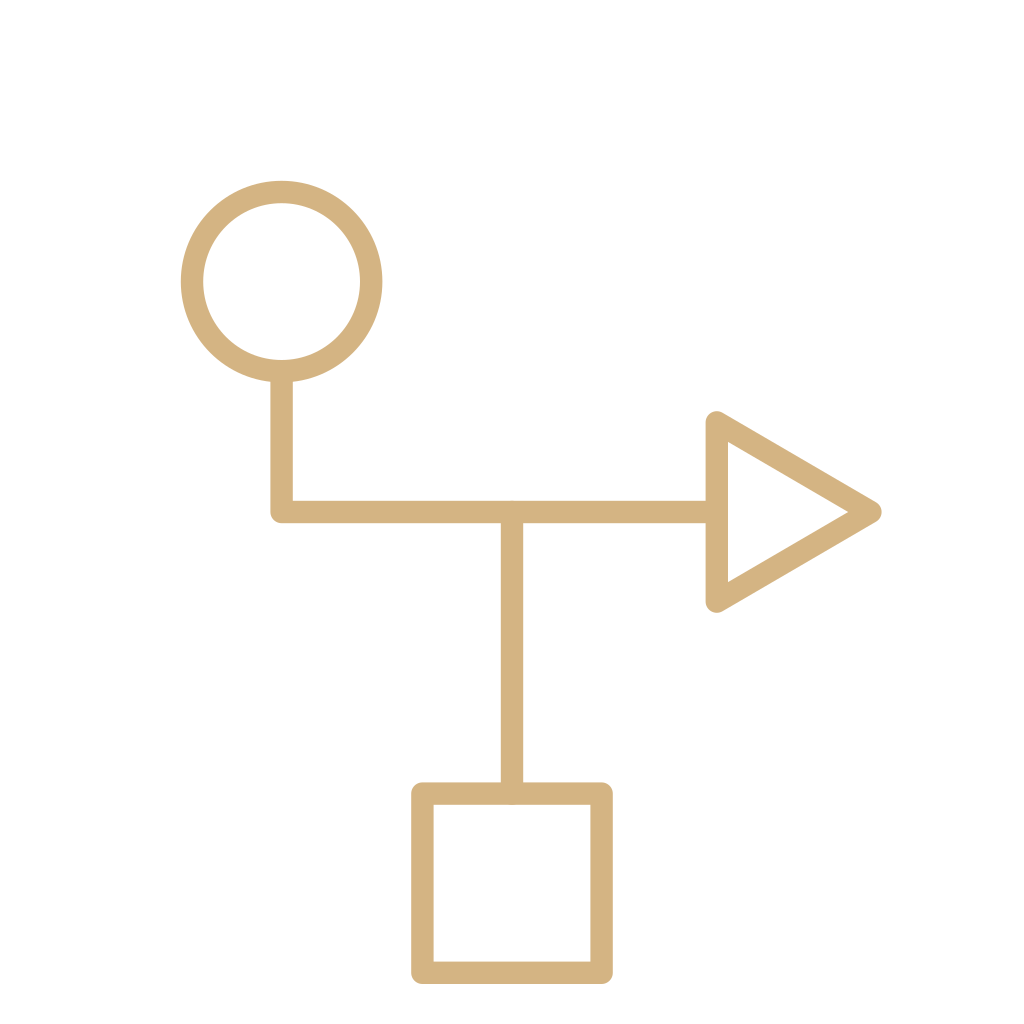
USB trident
Also called USB logo, Universal Serial Bus
The bus from 1996; the mark is the implementers’ emblem
Modern symbolsUSB trident meaning
The USB mark is a branching emblem for the Universal Serial Bus, introduced in the mid-1990s. It has no Unicode character. The Neptune-like trident is a resemblance, not the origin. The lexicon draws its own schematic and does not reproduce the USB-IF file. Later SuperSpeed badges are branding, not a new symbol.
A branch for a bus. People noticed that it looks like a trident.
The name. USB expands to Universal Serial Bus. The trident is a nickname for the emblem, not the standard’s name. Neptune’s weapon is a metaphor readers added because the silhouette branches in three.
Where it comes from
Universal Serial Bus was developed in the middle of the 1990s by a group of computer companies to replace a drawer of incompatible ports. The specification history starts with USB 1.0 in 1996. The emblem that shipped with the idea is a circle with a stem that splits into three arms, ending, in the official file, in a circle, a triangle, and a square. Those three tips were explained as the different kinds of device the bus could serve. That functional story is the one the implementers’ material supports. A second story, repeated in interviews and in design chatter, says the branch was meant to recall Neptune’s trident, a tool that could do more than one thing. The resemblance is obvious once someone says it. It is not a reason to file the bus under Roman religion. This page exists so the resemblance has somewhere accurate to go. There is no code point. A font that shows a trident is showing Neptune, or a weapon, or an emoji. It is not showing the bus. SuperSpeed, from USB 3.0 onward, added letters and a different badge to the same family. USB4 continued the branding. Those are versions. They are not ancient variants. The drawing in this lexicon is an original branch of three strokes. It is not a trace of the USB Implementers Forum artwork, and it is not licensed as their mark.
Modern
A port, then a silhouette
The useful fact is the bus: one connector family, a host, devices, a direction of power and of data. The emblem is how you find that family on a casing. If the emblem is missing, the specification still exists. If the specification is missing, the emblem is a picture of a branch. Design writing sometimes stops at the picture. The page starts at the year and the problem, a surplus of ports, and treats the trident as the label that won.
Modern
Not Neptune, not a character
Neptune’s glyph is ♆, a printed trident with a code point and a discovery date of 1846. The USB branch has no code point and a design date in the 1990s. Putting them on neighboring pages is the point of the link. Copying one file onto the other page would be the mistake. You can see the rhyme. You should still be able to say which object you are holding. A cable is not a planet. A planet is not a standard.
In popular culture
brand · 1996
USB-IF trident logo
The mark is called the trident logo. Using it requires compliance tests and a yearly fee. German press reads the branch as Neptune’s trident set over older ports, and the circle, square, and triangle tips as power, device, and data.
The tip meanings are widespread but officially unconfirmed.
Sourcebrand · 2008
'SS' SuperSpeed mark
USB 3.0 added 'SS' to the trident.
USB 3.0 added 'SS' to the trident, which is a later reading of the mark.
SourceWorth knowing
Questions
What does the USB trident mean?
The USB mark is a branching emblem for the Universal Serial Bus, introduced in the mid-1990s. It has no Unicode character. The Neptune-like trident is a resemblance, not the origin. The lexicon draws its own schematic and does not reproduce the USB-IF file. Later SuperSpeed badges are branding, not a new symbol.
Where does the USB trident come from?
Universal Serial Bus was developed in the middle of the 1990s by a group of computer companies to replace a drawer of incompatible ports. The specification history starts with USB 1.0 in 1996.
Near this
Sources
Named when the entry depends on a text, a date, or a standard. Catalog numbers are not invented.
Your margin
Private. It stays in this browser and never joins the canon.
symbol.wiki, edited as Sigilla. Last reviewed 20 October 2026. A reading of public tradition, not a ruling.