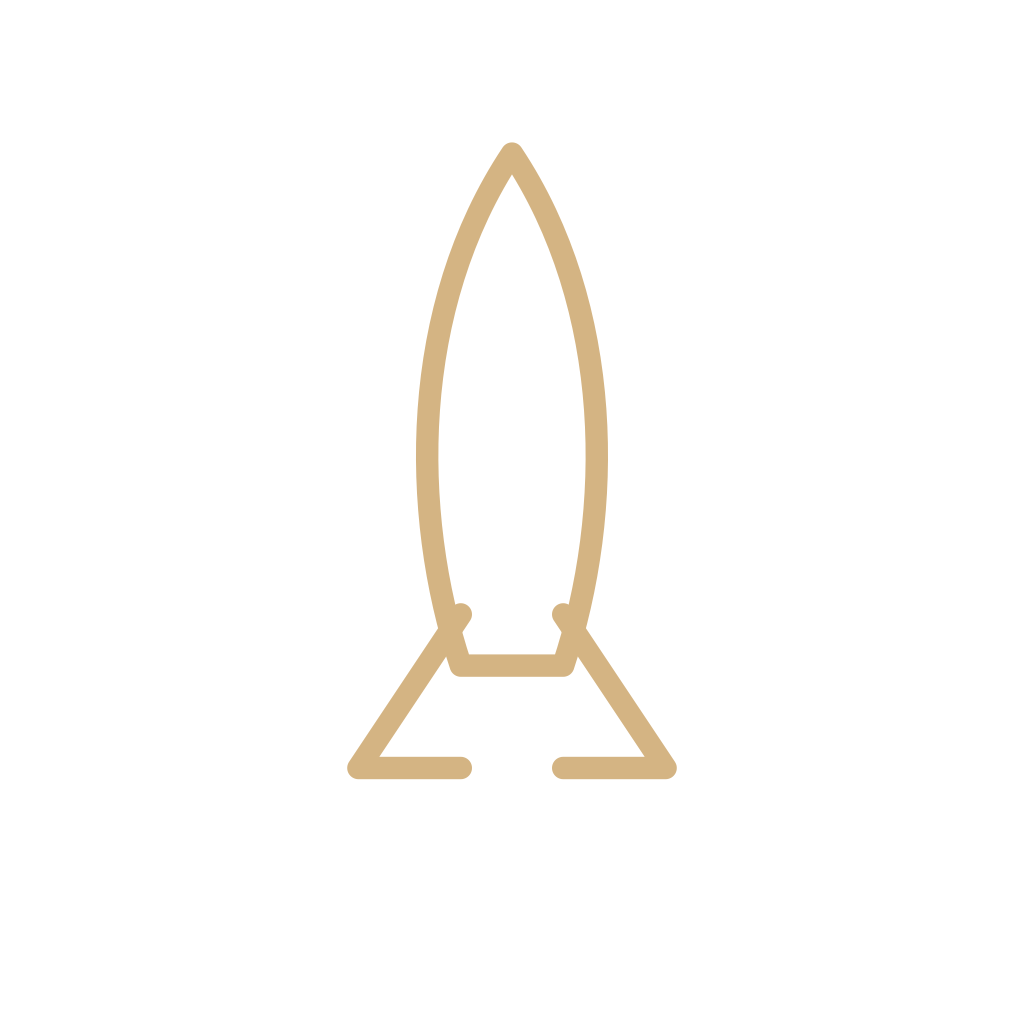
Rocket
Also called the rocket silhouette, 🚀
The weapon’s shape in the 1940s; the friendly shape in 1953
Modern symbolsRocket meaning
The rocket symbol is the pointed body with fins. The German V-2, first flown in 1942 and used as a weapon in 1944, is the silhouette’s parent. Tintin’s Destination Moon in 1953 made a friendlier version famous. The emoji is a further cartoon of that friendly version.
A pointed body and fins. A weapon’s outline, later a toy’s.
The name. Rocket is an old word for a self-propelled firework and then for a vehicle. The silhouette this page means is the twentieth-century one: a cylinder, a nose, and fins. That outline was fixed by weapons, especially the V-2, and then domesticated by pictures.
Where it comes from
The Aggregat 4, called the V-2 by the German ministry of propaganda, was the first long-range guided ballistic missile. Wernher von Braun’s group developed it at Peenemünde. It was used against cities in 1944 and 1945. The shape, a tall finned body, became the default drawing of a rocket even when later vehicles, orbital ones, dropped the big fins. After the war the same shape entered children’s books. Hergé’s Objectif Lune, Destination Moon, was published in 1953, with Explorers on the Moon the following year. Tintin’s rocket is red and white, checked, and inhabited. It is a V-2 that has been allowed into a comedy. The emoji U+1F680 is a further step: a toy, often with a porthole and a flame, no longer a weapon and no longer a particular book. The lexicon draws the finned silhouette. It does not draw the V-2’s insignia and it does not copy Hergé’s checkerboard. Those are other people’s pictures. The shape is common enough to be a symbol. The history of the shape is not common. It starts as a weapon.
Modern
Fins outlived their job
Fins stabilize a vehicle in air. A rocket above the atmosphere does not need them in the same way. The symbol kept them because the V-2 had them and because a finned body reads as a rocket to a child. Readability won over engineering. That is normal for a symbol. It is a bad guide to how a launcher is built. Saturn V and its successors are not the emoji. The emoji is a memory of a shape that was already a memory of a weapon.
In fiction
comic · 1953
A weapon shape, checked and boarded
Destination Moon (Tintin, 1953)
Hergé sent Tintin to the Moon in a rocket that a reader of 1953 could recognize as kin to the V-2 and could still love. The book is careful about technical advice and careless, in the way fiction is allowed to be, about the political origin of the silhouette. The care and the carelessness are both part of the symbol’s second life. Children met the rocket as an adventure. The adventure did not cancel the weapon. It put a checkerboard on it. The emoji inherits the adventure. This page keeps the weapon in the same paragraph.
Destination Moon (comics)In popular culture
film · 1929
Woman in the Moon (Fritz Lang)
Invented the launch countdown and showed a multistage rocket so plausibly the Nazis later banned it for fear of V-2 leaks.
Invented the launch countdown and showed a multistage rocket so plausibly the Nazis later banned it for fear of V-2 leaks, a later reading.
Sourceother · 2026
LEGO Ideas Tintin's Rocket (21367)
A 1,283-piece, 49 cm checkerboard rocket with a removable panel.
A 1,283-piece, 49 cm checkerboard rocket with a removable panel, which is a later reading of the mark.
SourceWorth knowing
- The V-2's black-and-white checkerboard let observers track roll at launch; Hergé borrowed it. Source
Questions
What does the Rocket mean?
The rocket symbol is the pointed body with fins. The German V-2, first flown in 1942 and used as a weapon in 1944, is the silhouette’s parent. Tintin’s Destination Moon in 1953 made a friendlier version famous. The emoji is a further cartoon of that friendly version.
How do I type the Rocket?
The character is 🚀 (U+1F680).
Why does Destination Moon use the rocket?
Hergé sent Tintin to the Moon in a rocket that a reader of 1953 could recognize as kin to the V-2 and could still love. The book is careful about technical advice and careless, in the way fiction is allowed to be, about the political origin of the silhouette.
Why does Woman in the Moon use the rocket?
Invented the launch countdown and showed a multistage rocket so plausibly the Nazis later banned it for fear of V-2 leaks. Invented the launch countdown and showed a multistage rocket so plausibly the Nazis later banned it for fear of V-2 leaks, a later reading.
Near this
- RobotA word from a play about forced labor. The tin man came after the word.
- Flying saucerA journalist’s phrase for a motion, which the public turned into a shape.
- AtomA nucleus and three orbits. A picture of a teaching model, not of an atom.
- Pioneer plaqueA metal card bolted to a machine, written for a reader who is not from here.
Sources
Named when the entry depends on a text, a date, or a standard. Catalog numbers are not invented.
Your margin
Private. It stays in this browser and never joins the canon.
symbol.wiki, edited as Sigilla. Last reviewed 20 October 2026. A reading of public tradition, not a ruling.