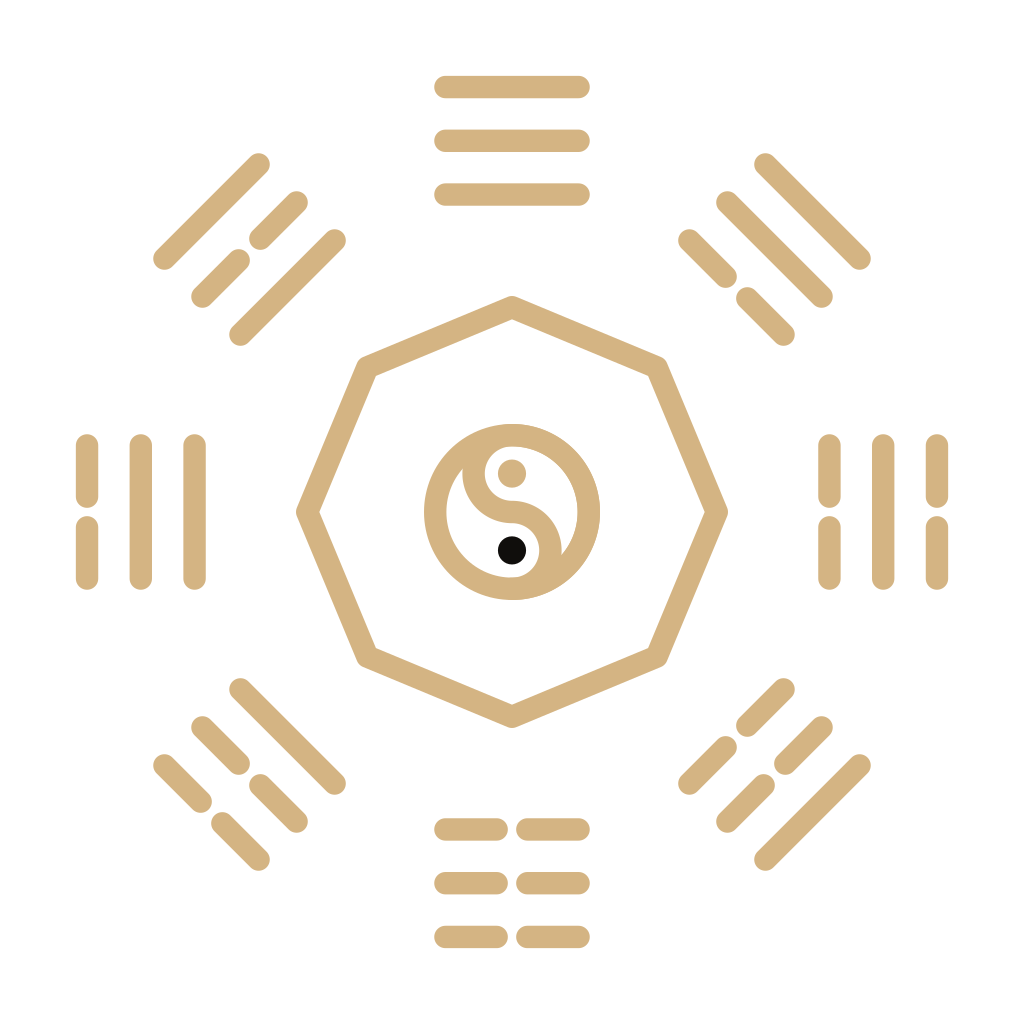
Bagua
Also called eight trigrams, ☰
The trigrams are classical; the printed set is the Yijing’s
East Asian symbolsBagua meaning
The bagua are the eight trigrams of the Yijing: every way of stacking three solid or broken lines. They are a classical Chinese sign system. The Unicode block from U+2630 to U+2637 encodes them. Lost, in 2004, put a bagua-like ring on fictional station logos. The ring is a reader. The trigrams are the source.
Eight arrangements of solid and broken lines. A system of signs, not a logo.
The name. Bagua means eight trigrams. Each trigram is three lines, and each line is whole or broken. The eight are all the combinations. The Yijing, the Book of Changes, is the text that organizes them. A television octagon is not the text.
Where it comes from
A solid line and a broken line are the two elements. Three places give eight trigrams: heaven, lake, fire, thunder, wind, water, mountain, earth, in the received naming. Stacking two trigrams gives the sixty-four hexagrams of the Yijing. The book is a divination text and a philosophical one. It is old, and its exact early history is argued. What is not argued is that the lines are a system, not a picture of an animal or a god. The familiar circular arrangement, the bagua as a ring, is a later diagram for display and for feng shui practice. Display is not the book. Leibniz, in 1703, was delighted by a Jesuit account of the lines and treated them as kin to his binary arithmetic. Kinship is his reading. The Yijing is not an essay on place value. Unicode encodes the eight as characters U+2630 through U+2637, from TRIGRAM FOR HEAVEN, ☰, onward. This page shows heaven’s trigram in the character slot and describes the set. The lexicon draws a ring of trigrams as a schematic of the diagram, not as a temple painting.
East Asian
Lines before the swirl
The taijitu, the yin-yang swirl, is what most readers expect from a Chinese symbol page. The trigrams are older as a system and plainer as a drawing. They are the combinatorial fact under a great deal of later ornament. A page that starts with the swirl and never shows a broken line has started at the souvenir. Start at the line. Whole or broken, three times, eight ways. The rest is arrangement, commentary, and use.
In fiction
tv · 2004
An octagon where the book should be
Lost (TV, 2004)
Lost marks its Dharma Initiative stations with an octagonal logo. Several of the logos include a ring of trigrams, a bagua used as a corporate seal inside the fiction. The show ran from 2004. The seal means, in the story, a research project with a bureaucracy and a set of stations. It does not mean the producers were transmitting the Yijing. A viewer who wants the eight trigrams can learn them. A viewer who wants the octagon is watching television. The octagon is a reader of the ring diagram, the way a university seal is a reader of a book it does not reproduce. This page links the two so the book stays first.
Dharma InitiativeIn popular culture
flag · 1883
Flag of South Korea
Four trigrams (qian, kun, kan, li) frame the taegeuk.
Half the set, read as heaven, earth, water, fire.
SourceWorth knowing
Questions
What does the Bagua mean?
The bagua are the eight trigrams of the Yijing: every way of stacking three solid or broken lines. They are a classical Chinese sign system. The Unicode block from U+2630 to U+2637 encodes them. Lost, in 2004, put a bagua-like ring on fictional station logos. The ring is a reader. The trigrams are the source.
How do I type the Bagua?
The character is ☰ (U+2630).
Why does Lost use Bagua?
Lost marks its Dharma Initiative stations with an octagonal logo. Several of the logos include a ring of trigrams, a bagua used as a corporate seal inside the fiction.
Near this
Sources
Named when the entry depends on a text, a date, or a standard. Catalog numbers are not invented.
Your margin
Private. It stays in this browser and never joins the canon.
symbol.wiki, edited as Sigilla. Last reviewed 20 October 2026. A reading of public tradition, not a ruling.