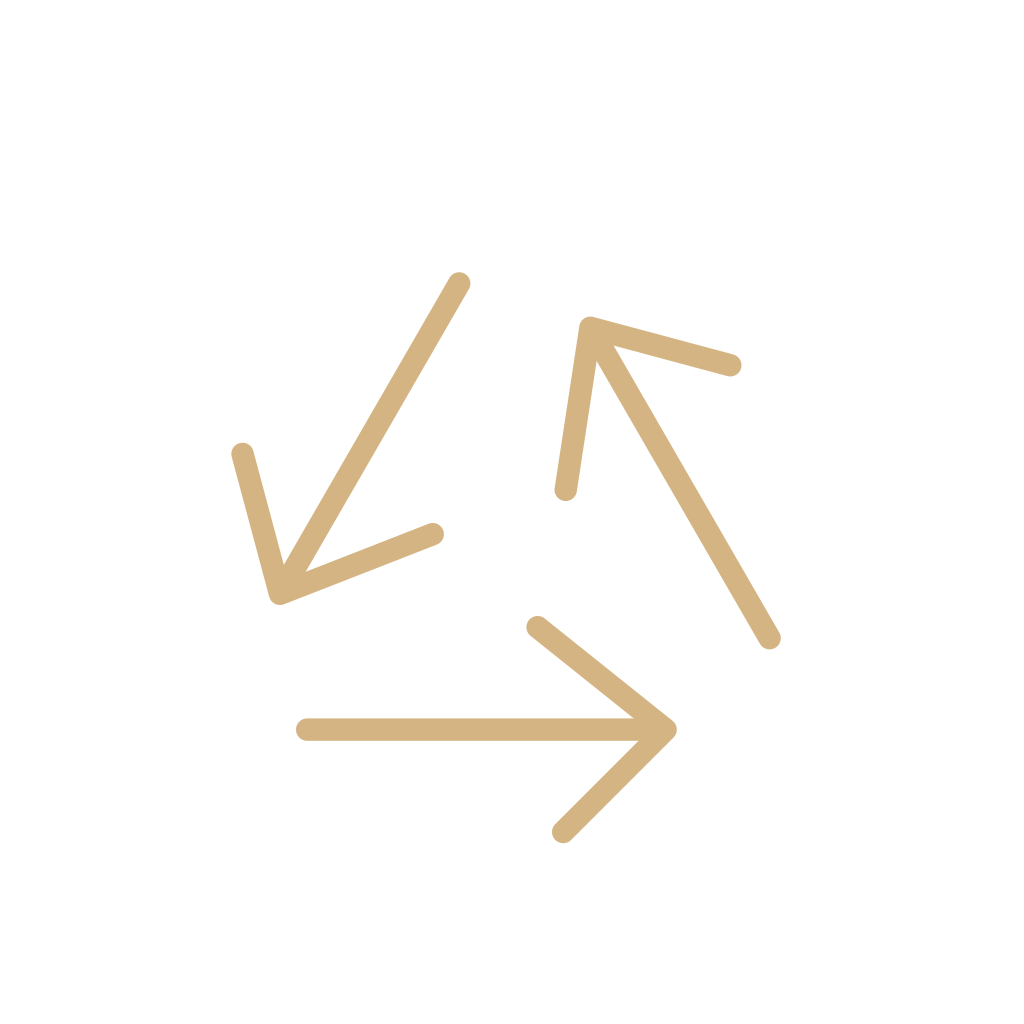
Recycling meaning
The recycling symbol was drawn in 1970 by Gary Anderson, a student, for a contest run by the Container Corporation of America. Three arrows fold around a Möbius loop. It marks a claim about materials, not a guarantee that a particular bin will take them. Unicode encodes it as U+267B.
Three arrows chasing on a one-sided loop.
The name. Recycling is an ordinary English word for returning a material to use. The mark gave the word a picture. The picture is Gary Anderson’s. The topology it depends on is older: the Möbius strip, 1858.
Where it comes from
In 1970 the Container Corporation of America, a large maker of paperboard, held a contest for a symbol for recycled paper, timed to the first Earth Day. Gary Anderson, a senior at the University of Southern California, sent a drawing of three arrows, each bent, chasing in a triangle that is also a Möbius loop. He won. The prize was small. The mark was not registered in a way that kept it in one owner’s hands, and it spread into municipal labeling, packaging, and law. The Möbius loop is the mathematical point: a strip with one surface, so the path has no clean inside. August Ferdinand Möbius described the strip in 1858. Anderson was using that fact as a metaphor for material that comes back. The metaphor is the design. It is not a proof that a bottle in a blue bin becomes a bottle again. Resin codes, the numbers inside a simpler triangle of arrows, were added later by the plastics industry and are often mistaken for the original mark. They are a coding system. They do not mean the object is recyclable in your city. Unicode’s BLACK UNIVERSAL RECYCLING SYMBOL is U+267B, ♻. The lexicon draws three chasing arrows. It is not Anderson’s submitted sheet, which was a student drawing, and it is not a municipal specification.
Modern
A contest, then a public habit
Anderson has said he was thinking of the Möbius strip and of roundness, of something that returns. The contest asked for a mark for recycled content. The public read it as a promise about the future of the object in their hand. Those are different sentences. The first is the designer’s. The second is a policy problem: whether a plant exists, whether the resin has a market, whether the truck picks up that polymer. The symbol cannot answer the policy. It can only mark the claim the printer decided to make.
Geometry
One surface, three arrows
The Möbius page in this cabinet is the surface. This page is the 1970 use of it. A loop with one side is a theorem. Three arrows are a graphic way to make a reader feel the direction of the theorem. Feel is not the same as the theorem. If you want the mathematics, read Möbius. If you want the contest and the bin, stay here. The infinity sign is a third drawing people mix in, a lemniscate for a magnitude. It is not a strip, and it is not Anderson’s mark.
In popular culture
brand · 1988
Resin identification codes
Chasing arrows around a number 1–7 identify the plastic, not its recyclability; in 2013 ASTM swapped the arrows for a plain triangle to reduce confusion.
The most consequential misreading of the mark.
SourceWorth knowing
- Anderson's design stood on its tip; the Container Corporation rotated it 60° to stand on its base. Source
- The original had one half-twist; most modern versions have three, every arrow folding over itself. Source
- More than 500 entries competed; Anderson won a $2,500 scholarship and the mark was left in the public domain. Source
Questions
What does the Recycling mean?
The recycling symbol was drawn in 1970 by Gary Anderson, a student, for a contest run by the Container Corporation of America. Three arrows fold around a Möbius loop. It marks a claim about materials, not a guarantee that a particular bin will take them. Unicode encodes it as U+267B.
How do I type the Recycling?
The character is ♻ (U+267B).
Near this
Sources
Named when the entry depends on a text, a date, or a standard. Catalog numbers are not invented.
Your margin
Private. It stays in this browser and never joins the canon.
symbol.wiki, edited as Sigilla. Last reviewed 20 October 2026. A reading of public tradition, not a ruling.