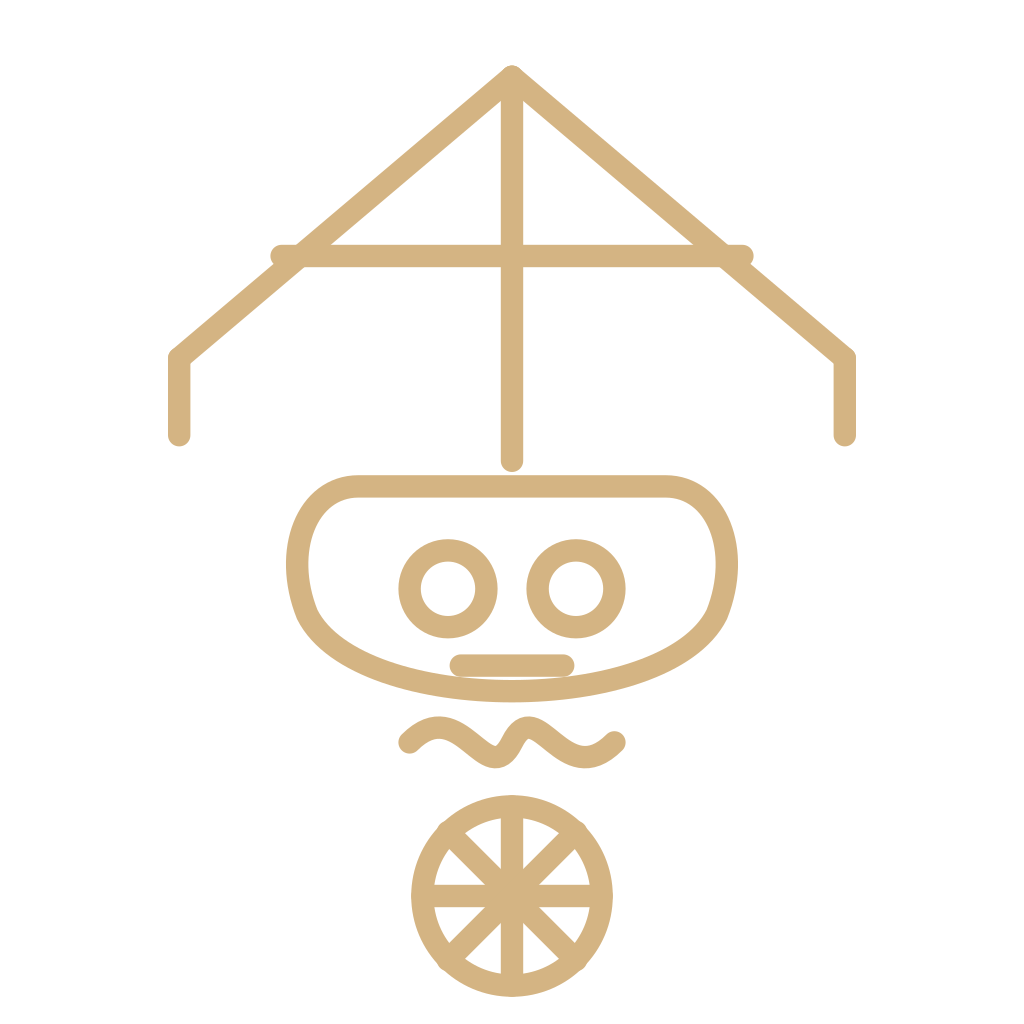
Memento mori
Also called remember you must die, the Pompeii level, vanitas
The Pompeii emblem, 1st century BC; the Latin phrase in its common form is medieval
Stoic symbolsMemento mori meaning
Memento mori means remember that you have to die. The oldest complete statement of that in one image is a Pompeian mosaic: death is the plumb-bob on a builder’s level, weighing a king’s purple against a beggar’s bag.
Unicode
None of the typed skulls is the Pompeii emblem. Nearest characters: ☠ U+2620 skull and crossbones, 💀 U+1F480 skull, ⌛ U+231B hourglass.
Remember that you have to die. The oldest complete picture of it is a level, a skull, and a wheel.
The name. Latin memento, remember, a future imperative of meminisse; mori, the infinitive of morior, to die.
Where it comes from
The grammar is plain. Memento is a future imperative of meminisse, and mori is the infinitive of morior: remember that you have to die. The picture is older than the phrase in its common medieval form. The mosaic is Museo Archeologico Nazionale di Napoli inv. 109982, 47 by 41 centimetres, from the first century BC. It came from Pompeii I 5,2, the house-workshop identified as the tannery of M. Vesonius Primus, where it formed the top of the triclinium table in the peristyle garden. It was excavated in 1874.
The museum reads a mason’s level with a plumb line as the leveling of human differences. The skull is death, and so oddly shaped that some think it a monkey’s. The butterfly is the lightness of the soul. The wheel is a clear allusion to fortune. A sceptre and purple on the left arm are power and wealth. A beggar’s stick and bag on the right are poverty. One may be rich or poor, but before death the two arms balance. Warscher’s 1936 record adds the green ground, the bronze-plated level, and the red butterfly wings. Niccolini in 1862 thought the emblem unique among the city’s mosaics.
The Stoic connection is textual, not visual. Seneca’s letters are full of injunctions to meditate on death. Epictetus told students to remind themselves, while kissing a child, that the child is mortal. Marcus Aurelius told himself to consider how ephemeral and mean all mortal things are. The triumph story, a slave whispering to a general, rests on Tertullian, Apologeticus 33.4, written about 197: Respice post te! Hominem te memento! The line is his. Each part of that story is attested on its own. No ancient account stages them as one scene.
Stoic
A sentence, then a still life
The philosophers told a reader to keep death in view. Painters later gave that sentence a kit: skull, hourglass, snuffed candle, wilting flower. The Pompeii table already had the sentence as a tool, a level, centuries before the vanitas shelf. The revival’s coins borrow the shelf. They do not borrow the mosaic.
In popular culture
play · c. 1600
Hamlet
Yorick’s skull is the memento mori everyone can name. A prince speaks to a jester’s bone, and the graveyard does the teaching.
The scene is a later picture of the sentence. It is not the Pompeii table.
Sourcepainting · 1533
The Ambassadors
Holbein smears a skull across the floor of a double portrait. It resolves only when the viewer stands at the side.
The anamorphosis is a sixteenth-century device. The reminder is older.
Sourcepainting · c. 1671
Vanitas
Philippe de Champaigne sets a tulip, a skull, and an hourglass together: life, death, and time. Modern Stoic medallions copy this triad.
A Jansenist still life became the best-known Stoic object of the 2010s. The painting is not a Stoic textbook.
Sourceobject · 16th century
Mary, Queen of Scots
She owned a watch carved as a silver skull, engraved with Horace on death knocking equally at hovels and towers.
The watch is a court object. It is not a school emblem.
Sourcenovel · 1953
Fahrenheit 451
Bradbury gives the triumph line as “Remember, Caesar, thou art mortal.”
The novel inherits the warning and the name Caesar. It does not inherit Tertullian’s wording.
Sourcefestival · 1910
Día de los Muertos
Mexico’s Day of the Dead sugar skulls, and José Guadalupe Posada’s La Calavera Catrina of 1910, keep the skull in a living festival.
A festival and a print. Not a Stoic exercise, and not the Pompeii level.
SourceWorth knowing
- Public clocks carried vulnerant omnes, ultima necat: they all wound, the last kills. Source
- The Évora bone chapel greets visitors with the line: we bones, lying here bare, await yours. Source
- Niccolini in 1862 thought the Pompeii emblem unique among the city’s mosaics. Source
- The skull on the mosaic is oddly shaped, and has been read as a monkey’s. Source
Questions
Is memento mori a Stoic phrase?
The sentence is Latin, and the common form is medieval. Stoic writers do tell you to meditate on death: Seneca, Epictetus, and Marcus. The picture language is Roman, then Christian, and only later a Stoic brand.
What does the Pompeii memento mori mosaic show?
A builder’s level with a plumb line down to a skull, a butterfly, and a wheel. Wealth hangs on one arm and poverty on the other. The museum reads it as death leveling the difference.
Did a slave really whisper “remember you are mortal” to Roman generals?
Tertullian, writing about 197, gives the line as Respice post te, hominem te memento. The sentence is his. This page does not turn it into one fixed scene from the Republic.
Near this
Sources
- Memento mori
- MANN, the Pompeii memento mori mosaic
- Pompeii in Pictures, I 5,2
- Live Science, the mosaic before the eruption
- Tertullian, Apologeticus 33
- Perseids, Tertullian Apologeticus 33
- AskHistorians, on the triumph whisper
Named when the entry depends on a text, a date, or a standard. Catalog numbers are not invented.
Your margin
Private. It stays in this browser and never joins the canon.
symbol.wiki, edited as Sigilla. Last reviewed 20 October 2026. A reading of public tradition, not a ruling.